A personal hobby of mine is to ask two different chatbots the same question and see which one provides the best response. Like a professor quizzing students (which I sometimes do in real life as a volunteer), I evaluate whether the bot is hallucinating and making up facts or whether it provides an intelligent and coherent answer that is actually useful.
“Intelligence” and “coherence” are not the words I’d use to describe what chatbots have usually generate when it comes to images. Known as AI slop, these strange concoctions — often with a blurred background, a perfect human with coiffed hair, and maybe a few extra thumbs — are all over social media and even show up as the feature image in articles like this.
Stock images already have a bad name. This video with Emilia Clarke is still one of my all-time favorite stock photo parodies and makes me laugh even though it came out long before AI slop:
Times have changed. OpenAI recently upgraded the ChatGPT image generation model to compete with Google Gemini and Nano Banana Pro.
Surprisingly, the images don’t use that distinctive blur anymore and, in my tests, often look far more realistic than before.
I decided to use the exact same prompts with both chatbots and see which one produced the most useful results. I’m talking: an image you might use in an ad campaign or with an article, something you would post on social media to accompany a witty caption.
ChatGPT impressed me with its speed — none of the stock images looked like computer-generated garbage. However, Nano Banana Pro has the upper hand because it consistently generated more realistic images in my tests. Here are the prompts I used and the images both bots generated so you can judge for yourself. (Nano Banana images are on the left.)
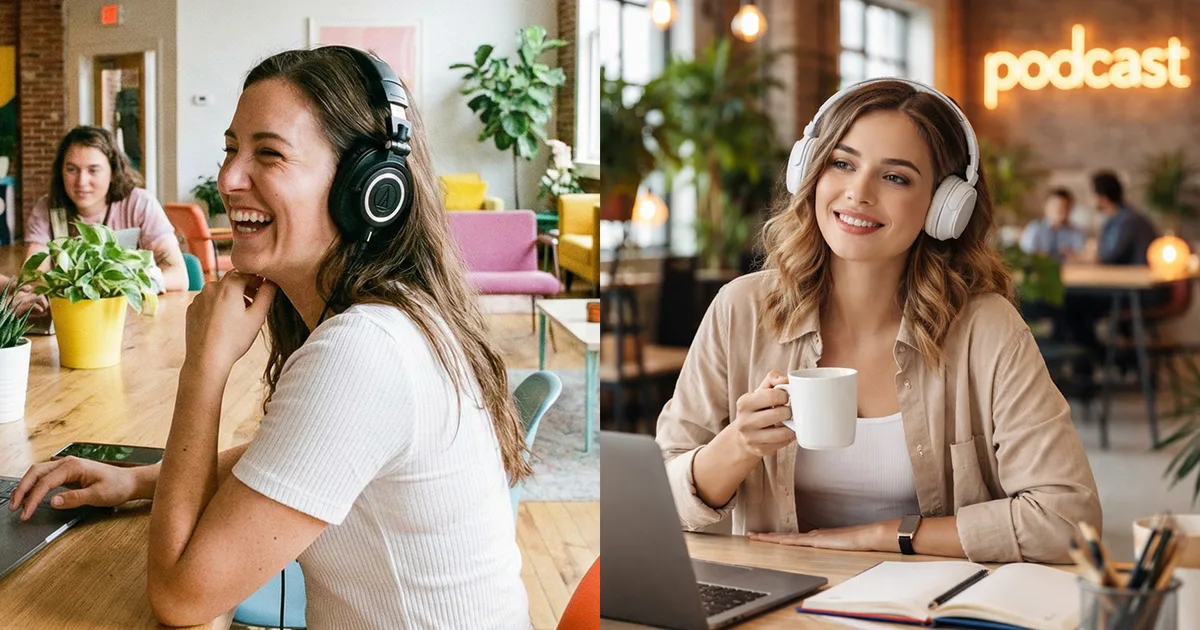
1. Person listening to a podcast

Prompt used: Make a stock image of someone listening to a podcast in a trendy office
I asked both bots to make an image of someone listening to a podcast in an office. Nano Banana was the clear winner here, although the Nano Banana image does have a slight blur in the background that might be a dead giveaway. Yet, AI is learning to avoid absolute perfection. Honestly, I’d have a hard time knowing the woman in an office setting in the Nano Banana shot wasn’t real. Her hair is slightly messy (like someone in real life). In the ChatGPT shot, the podcast listener doesn’t look quite right — the photo is a little too perfect.
2. Create a promo image for my book

Prompt used: Put this book cover in the hands of someone who is really interested in reading it
For this test, I uploaded the cover to my own book and asked the bots to make an image of someone reading it. Nano Banana went a little over the top, since the AI image shows someone with a little too much enthusiasm. Yet, the ChatGPT image still has an otherworldly quality (and I mean that in a bad way) that doesn’t seem real. Everything about the ChatGPT image is too perfect — the lighting, the pose, etc. — and still screams CGI.
3. Create a stock image to use with an article

Prompt used: Create a stock image to go along with an article about AI image generation
Nano Banana didn’t win every battle this time. I asked both bots to create an image to go along with this article. ChatGPT produced a somewhat useful image that’s still a little too fake, but Nano Banana Pro broke the fourth wall with a computer-generated image that superimposes a brain and a paintbrush on top of an Apple iPad. In other words — it’s not at all useful.
4. Leadership struggles

Prompt used: Show someone struggling to achieve a leadership goal, but make it look really realistic
One of the most common stock photos you’ll see shows someone struggling to achieve a goal — e.g., climbing a mountain, raising their arms to the sky, or jumping across a ravine. The reason this stock image is so popular is because the photos are relatable — we all struggle to succeed. I would say both Nano Banana Pro and ChatGPT produced subpar results. The stock images they made show someone frustrated in an office with crumpled papers. Still, Nano Banana has a slightly more realistic look.
5. Emilia Clarke smiling at the camera

Prompt used: Create a new stock image showing Emilia Clarke smiling at the camera in an office
For one final test, I asked both bots to create a new image of Emilia Clarke smiling at the camera in an office. I was surprised that ChatGPT refused to make the image, saying Clarke is a “real, identifiable person” whereas Nano Banana was happy to oblige. With some coaxing, I asked ChatGPT to generate someone who looks like Clarke. The Nano Banana image is actually not that bad — it doesn’t look completely fake.
Final thoughts
AI image generation has come a long way. None of the photos produced by Nano Banana Pro or ChatGPT showed someone with six fingers or three arms. They all looked semi-realistic. A few of the Nano Banana images were realistic enough that I could see using them on social media or for other purposes, and ChatGPT is definitely improving. My prediction? By this time next year, we won’t be able to tell the difference between a real photo and a fake one.


