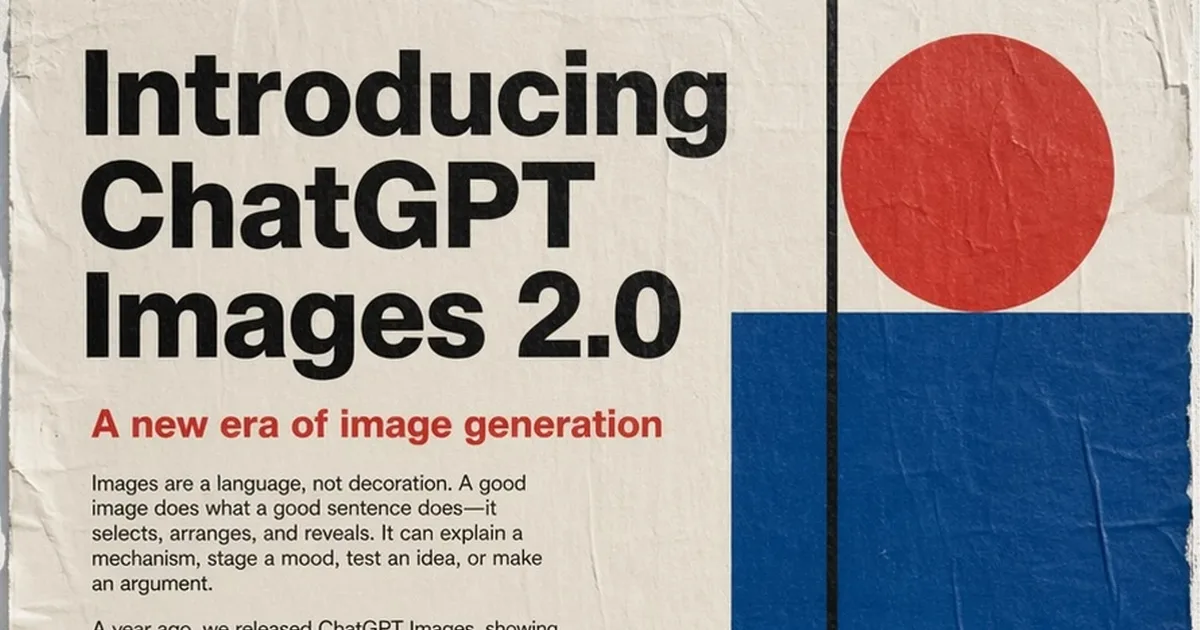
The latest image generator from OpenAI is undeniably powerful, and that much is hard to dispute. It interprets prompts with a level of depth that feels closer to collaboration than execution, renders clean and usable text within images, and produces outputs that look less like drafts and more like finished products.
But the real shift is not visual quality. It is conceptual. This tool is not just improving how images are made; it is quietly redefining what creative control looks like in an AI-assisted workflow. And that shift, while impressive, is not entirely comfortable.
From Tool To Decision-Maker In A Changing Competitive Landscape
What separates ChatGPT’s image generator from most competitors is its reasoning layer. Instead of simply translating prompts into visuals, it interprets intent, fills in missing context, and makes decisions before generating the final output. This allows it to handle complex, multi-step prompts and even maintain consistency across multiple images in a way that feels far more structured than traditional systems.
That puts it ahead of platforms like Midjourney and Stable Diffusion, which still rely heavily on precise prompting and iterative trial-and-error. But that advantage comes with a subtle trade-off. As the system takes on more decision-making, the user’s direct control begins to shrink. Creativity becomes less about crafting and more about guiding.
At the same time, the competition is evolving in different directions. Google’s Gemini-powered Nano Banana has emerged as a serious challenger, focusing on speed and consistency rather than reasoning depth. It can generate images in seconds, maintain subject continuity across edits, and combine multiple visual inputs seamlessly. Its rapid adoption and viral usage trends suggest that efficiency and accessibility are resonating strongly with users.
Meanwhile, Midjourney continues to dominate in artistic expression, producing images with strong stylistic identity, mood, and visual storytelling. It remains the preferred tool for creators who prioritise aesthetics over structure. Anthropic’s Claude, while not a direct image-generation competitor, is carving out relevance through structured workflows and design-oriented outputs, focusing more on how visuals are conceptualised than how they are rendered.
The result is a fragmented but mature market. The question is no longer which tool is best overall, but which tool fits a specific purpose. ChatGPT leads in versatility, but that leadership comes from balance rather than dominance.
The Text Breakthrough And The Uneasy Reality Of Realism
One of ChatGPT’s most significant technical achievements is its ability to render accurate, usable text within images. This has long been a weak point for AI image generators, with distorted typography often limiting real-world applications. By solving this, ChatGPT has unlocked new use cases in marketing, design, and communication, where precision matters as much as aesthetics.
However, this breakthrough has also exposed a more uncomfortable reality. A tweet highlighted a viral AI-generated cheque for ₹69,000 that appeared convincingly real, complete with structured banking details. The image sparked immediate concerns around fraud, with users pointing out how easily such visuals could be misused despite lacking physical security features. Oh, and the image was made with ChatGPT 2.0.
This incident illustrates a broader tension. The same capability that enables better design also enables more believable deception. As AI-generated visuals become more functional and realistic, the line between creative output and potential misuse becomes increasingly blurred.
Photorealism plays a central role in this shift. ChatGPT excels at producing commercially usable visuals such as product shots, advertisements, and UI mockups. Nano Banana competes closely in this space, often outperforming in speed and consistency, while Midjourney continues to lead in artistic imagination. This creates a clear divide between tools optimised for usability and those designed for expression.
Also, comparing GPT Image 2 with Nano Banana 2 makes one thing clear: they are optimised for very different kinds of output. GPT Image 2 excels in structured, usable visuals where precision matters. Its text rendering is nearly flawless, making infographics, UI mockups, and product shots look polished and production-ready, while its hyper-realism pushes images close to photographic quality – sometimes uncomfortably so.


However, it still struggles when scenes require believable physics or motion, where objects can feel slightly off. Nano Banana 2, on the other hand, handles these dynamic elements better, producing more natural movement, cinematic lighting, and skin textures that feel less synthetic. It also enables faster iteration when generating multiple variations quickly. In practical terms, GPT Image 2 feels like a design tool, while Nano Banana 2 behaves more like a creative engine, prioritising visual feel over structural perfection. In the two images above, we gave the prompt – “make a fire engine parked outside the Avengers Tower” – and looking at the images, the Nano Banana one seems more realistic while the ChatGPT one feels more, you could say, wallpaper worthy. Gemini has actually taken the liberty of putting a “Heroes Welcome” sign on the entrance of the building on a busy NY street. While the ChatGPT one has followed the instructions to the T. It’s just a fire engine standing in front of the Avengers Tower. That is it.
Convenience, Control, And The Future Of Creativity
Perhaps the most transformative aspect of ChatGPT’s image generator is its workflow. Conversational editing allows users to refine images iteratively using natural language, eliminating the need to start over with each change. This makes the process faster, more intuitive, and significantly more accessible.
Compared to the friction of prompt engineering in Midjourney or the technical complexity of Stable Diffusion pipelines, this approach feels like a leap forward. But it also changes how creative ideas are formed. When iteration becomes effortless, the process risks becoming reactive rather than intentional. Instead of carefully crafting a vision, users may find themselves adjusting outputs until something works.
This is where the broader question emerges. ChatGPT offers the most complete package in the current landscape, combining reasoning, usability, text accuracy, and integration into a single system. It performs consistently well across multiple use cases, which is why it is increasingly seen as the default choice for general users.
Yet that “overall” strength hides an important nuance. Nano Banana is faster and often more consistent. Midjourney remains more artistic. Claude is more structured. Stable Diffusion offers deeper customisation. ChatGPT does not dominate any single category outright, but it succeeds by being good at everything.
That shift reflects a larger change in how tools are chosen. The decision is no longer driven by creative identity, but by efficiency and practicality. While that represents progress in accessibility and capability, it also suggests a quieter transformation.
Creativity is becoming less about expression and more about optimisation.


